

From Fragmented Systems to Nationally Resilient Data Ecosystems
By Waseem Khan
Across the United States, critical sectors such as healthcare, education, government, and research are under sustained pressure to modernize. (Cybersecurity and Infrastructure Security Agency, 2024). Yet many institutions still rely on fragmented systems, disconnected records, manual workflows, and inconsistent governance
practices. These weaknesses create inefficiency, increase security risk, slow service delivery, and reduce resilience across essential services. The future of digital transformation in the United States depends not only on adopting technology, but on building governed digital infrastructure that is secure, interoperable, and resilient.
Figure 1. Fragmented systems versus governed digital infrastructure.
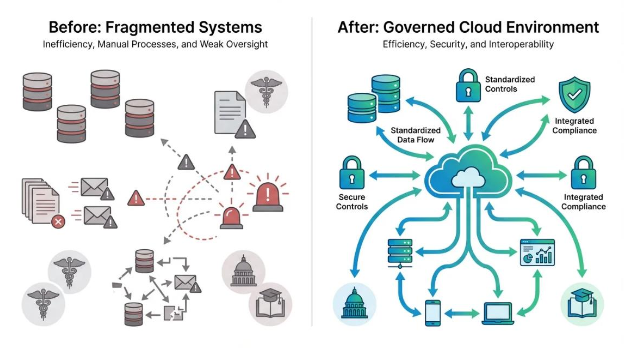
A governed digital infrastructure is designed with structure, accountability, and long-term usability in mind. Rather than treating technology as a collection of separate tools, it combines cloud platforms, automation, data governance, identity management, security controls, and lifecycle policies into one coordinated environment. In critical sectors, this approach is essential because the value of digital systems is measured not only by speed and convenience, but by trust, continuity, and the ability to protect sensitive information.
One of the most serious problems in many U.S. organizations is fragmentation. Different departments often use different systems, store information in separate repositories, and follow inconsistent procedures. This creates silos that make it difficult to share information securely or use it effectively. In healthcare, fragmentation can affect patient coordination, records access, clinical workflows, and research support. In government and education, it can lead to delays, duplicated work, compliance gaps, and weak visibility into operations.
Figure 2. Common consequences of fragmented systems.
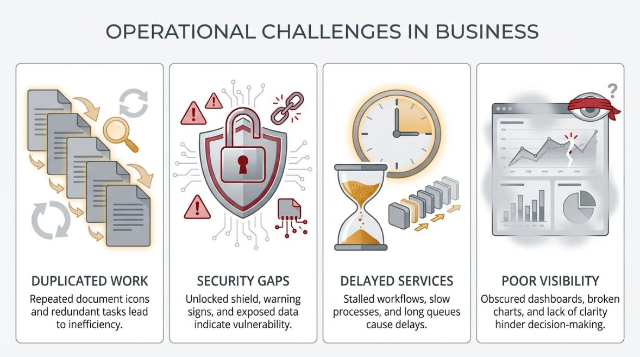
Fragmented systems also make it harder to apply consistent cybersecurity and retention policies. As a result, institutions become more vulnerable to human error, data loss, and unauthorized access. The problem is not purely technical; it is organizational. When information architecture is weak, governance becomes reactive instead of preventive. That is why digital modernization must begin with a structured approach to how information is organized and controlled.
Governed infrastructure addresses fragmentation by creating a shared framework for how information is stored, accessed, and used. This includes defining data structures, standardizing metadata, applying retention rules, managing permissions, and establishing audit trails. It also means designing systems that support multiple teams without sacrificing control. When governance is built into the architecture from the beginning, institutions are better able to maintain compliance, improve transparency, and scale operations without losing order.
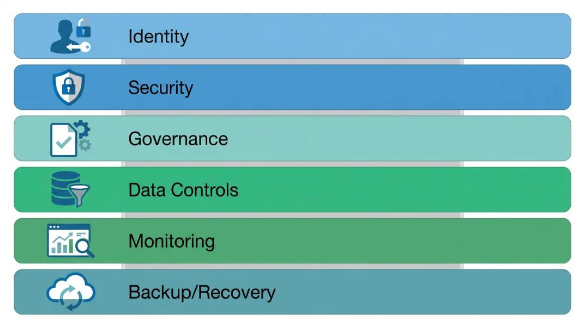
Cloud technologies play a major role in this transformation. Platforms such as Microsoft Azure and Microsoft 365 allow organizations to move away from legacy infrastructure and toward secure, flexible, and scalable digital environments. But cloud adoption alone is not enough. Without proper governance, cloud systems can become just as disorganized as older environments. A well-designed cloud strategy must include identity and access management, data classification, encryption, monitoring, backup planning, and policy-based controls. (National Institute of Standards and Technology, 2024).
Figure 3. Core components of governed cloud infrastructure.
(Automation is equally important. Many critical-sector organizations still rely on manual processes for intake, approvals, records handling, reporting, and coordination. These manual workflows consume time, increase the chance of error, and limit organizational agility. Workflow automation can replace repetitive tasks with structured digital processes that are faster, more accurate, and easier to monitor. In healthcare, automation can support referral routing, document control, administrative approvals, and research coordination.
However, automation is only beneficial when it is designed responsibly. Poorly planned automation can create confusion, bypass oversight, or introduce compliance problems. That is why governance must be embedded at every stage. Automated workflows should reflect business rules, records requirements, privacy obligations, and security standards. When done properly, automation becomes a tool not just for efficiency, but for strengthening institutional discipline and reliability.
Another essential component of resilient digital infrastructure is interoperability. Critical sectors often depend on the ability of multiple systems to communicate with one another. In healthcare, patient care and research require secure exchange between clinical, administrative, and analytical systems. (Office of the National Coordinator for Health Information Technology, 2024). In education and government, interoperability supports continuity, reporting, and collaboration across departments or agencies. Without interoperability, data becomes trapped inside isolated systems, making it harder to use effectively.
Figure 4. Interoperability across healthcare, government, and research systems.
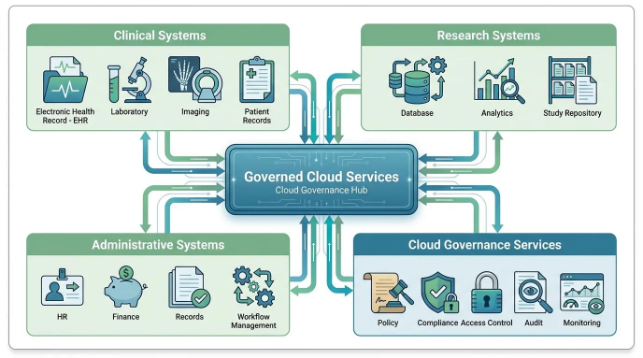
With interoperability, organizations can build ecosystems that are more responsive, adaptable, and useful to the public. This is especially important in healthcare and research, where collaboration depends on timely access to accurate information. Interoperability also reduces
duplication and improves data quality, both of which are essential to long-term digital resilience.
The human factor is just as important as the technical one. Digital transformation succeeds when professionals are trained to use, maintain, and improve the systems they adopt. Workforce development must therefore be part of any serious infrastructure strategy. Training in cloud administration, automation, cybersecurity, and governance helps organizations build internal capacity and reduce long-term dependence on outside support.
Figure 5. Workforce development as part of digital resilience.
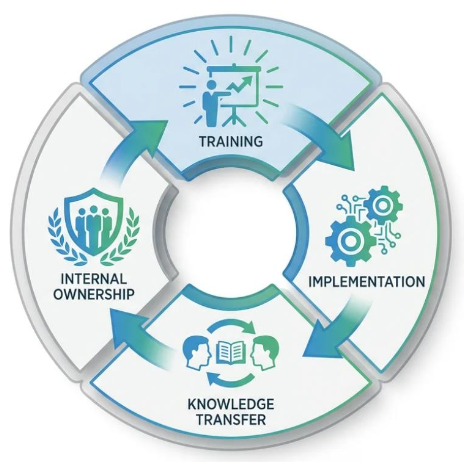
This matters because modernization is not a one-time project. It is an ongoing institutional capability. When staff understand governance, workflow logic, and secure cloud operations, institutions can sustain improvements after initial deployment. Workforce development also
supports continuity, reduces operational risk, and strengthens the ability of organizations to adapt to changing requirements.
Healthcare illustrates why governed digital infrastructure is so important. The sector manages sensitive patient and research data, operates under strict compliance obligations, and requires coordination across multiple roles and systems. The HIPAA Security Rule establishes national standards for protecting electronic health information, while the Privacy Rule addresses how protected health information may be used and disclosed. (U.S. Department of Health and Human Services, 2024). A governed digital environment can support clinical workflows, protect confidential information, and improve access to the right data at the right time.
In this sense, digital infrastructure is not just about technology adoption. It is about building systems that protect patients, support clinicians, and enable research. When governance, automation, and interoperability are aligned, healthcare institutions are better positioned to deliver reliable services and contribute to broader public health goals.
The broader lesson is clear: digital modernization must be approached as the deliberate design of a system, not as a series of isolated upgrades or disconnected technology investments. Too often, organizations pursue modernization through incremental tool adoption, only to find themselves with more complexity, not less. What critical U.S. sectors require instead is infrastructure that is secure by design, interoperable by structure, and resilient by default. This means cloud environments where governance is not an afterthought, but a foundational layer; automation that is not only efficient, but aligned with regulatory and operational realities; and workflows that reflect how people actually work, rather than forcing users to adapt to rigid systems. It also means building digital ecosystems that can evolve over time, absorbing new technologies, responding to policy changes, and scaling with institutional growth, without introducing instability or fragmentation.
As the United States continues to advance its digital modernization agenda, the institutions that will lead are those that move decisively beyond fragmented architectures and toward fully governed digital ecosystems. These environments enable more than operational efficiency; they create the conditions for trust, accountability, and sustained performance. They protect sensitive data through embedded controls, support complex operations through automation and integration, and empower the workforce through accessible and well-structured systems. Equally important, they ensure continuity, allowing institutions to adapt under pressure, whether driven by technological change, regulatory demands, or national-scale challenges. In this context, governed digital infrastructure should not be viewed merely as an IT strategy. It is a foundational component of national resilience, underpinning the ability of critical sectors to function effectively, securely, and reliably in an increasingly complex and data-driven world.
References
CISA / Critical Infrastructure: https://www.cisa.gov/topics/critical-infrastructure-security-and-resilience/critical-infrastructure-sectors
NIST Cybersecurity Framework 2.0: https://nvlpubs.nist.gov/nistpubs/CSWP/NIST.CSWP.29.pdf
ONC Interoperability: https://healthit.gov/interoperability/
HHS HIPAA Security Rule: https://www.hhs.gov/hipaa/for-professionals/security/laws-regulations/index.html
HHS HIPAA Privacy Rule: https://www.hhs.gov/hipaa/for-professionals/privacy/laws-regulations/index.html